
Top Machine Learning Algorithms
1. Introduction
Machine Learning is a branch of Artificial Intelligence that enables computers to learn patterns from data and make predictions or decisions without being explicitly programmed for every task.
Machine Learning algorithms are used in many real-world applications such as recommendation systems, fraud detection, customer analysis, medical diagnosis, image recognition, weather prediction, and price prediction.
Different Machine Learning problems require different algorithms. Some algorithms are designed for prediction, some for classification, some for clustering, and others for reducing the complexity of large datasets.
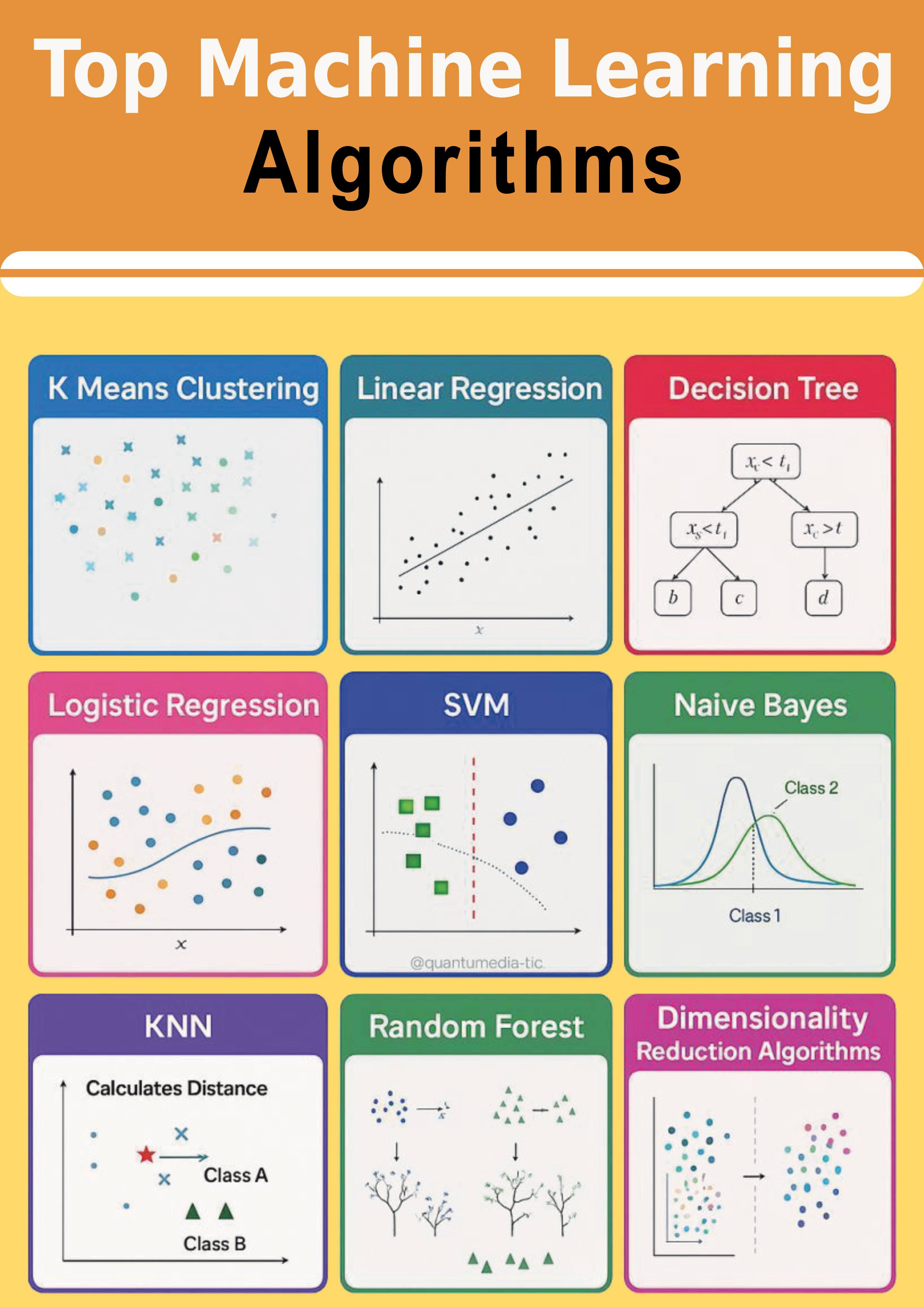
The most commonly used Machine Learning algorithms include:
K-Means Clustering
Linear Regression
Decision Tree
Logistic Regression
Support Vector Machine (SVM)
Naive Bayes
K-Nearest Neighbors (KNN)
Random Forest
Dimensionality Reduction
2. K-Means Clustering
K-Means Clustering is an Unsupervised Machine Learning algorithm used to group similar data points into different clusters.
The algorithm divides the dataset into a predefined number of groups called clusters.
For example, a shopping company can use K-Means to group customers based on age, income, shopping frequency, and spending amount.
Common Applications
Customer segmentation
Market analysis
Image compression
Pattern recognition
Document clustering
3. Linear Regression
Linear Regression is a Supervised Machine Learning algorithm used to predict continuous numerical values.
It learns the relationship between input variables and a numerical target variable.
For example, Linear Regression can be used for:
House price prediction
Car price prediction
Salary prediction
Student score prediction
Temperature prediction
The basic idea is to find a line that best represents the relationship between the input and output data.
Example:
Study Hours → Linear Regression → Exam Score4. Decision Tree
A Decision Tree is a supervised Machine Learning algorithm that can be used for both classification and regression.
It makes decisions by asking a series of questions about the input data.
For example, a loan approval system could use questions such as:
Is income high?
      |
      ├── Yes → Is credit score good?
      |             |
      |             ├── Yes → Approve
      |             └── No  → Reject
      |
      └── No → Reject
Decision Trees are easy to understand because their decisions can be represented visually as a tree.
Applications
Loan approval
Medical diagnosis
Customer classification
Fraud detection
Price prediction
5. Logistic Regression
Despite its name, Logistic Regression is mainly used for classification problems.
It predicts the probability of an input belonging to a particular category.
For example:
Email → Logistic Regression → Spam / Not SpamIt can also be used for:
Diabetes prediction
Titanic survival prediction
Sentiment classification
Customer churn prediction
Disease classification
Logistic Regression is especially useful when the output consists of categories such as Yes/No, 0/1, Positive/Negative, or multiple classes.
6. Support Vector Machine (SVM)
Support Vector Machine, commonly called SVM, is a supervised Machine Learning algorithm used mainly for classification.
SVM attempts to find the best decision boundary that separates different classes of data.
For example, if a dataset contains two types of objects, SVM tries to find a boundary that separates them as clearly as possible.
Applications
Image classification
Text classification
Face recognition
Pattern recognition
Bioinformatics
SVM can also work effectively with high-dimensional datasets.
7. Naive Bayes
Naive Bayes is a supervised classification algorithm based on Bayes' theorem.
It calculates the probability that a particular input belongs to a specific class.
It is especially popular for text-based Machine Learning applications.
For example:
"I really enjoyed this movie"
          ↓
     Naive Bayes
          ↓
       Positive
Applications
Spam detection
Sentiment analysis
Text classification
News classification
Document categorization
Naive Bayes is relatively fast and works well with large collections of text data.
8. K-Nearest Neighbors (KNN)
K-Nearest Neighbors, or KNN, is a supervised Machine Learning algorithm used for classification and regression.
The algorithm makes predictions by looking at the closest data points to a new data point.
For example, if most of the nearest neighbors belong to Class A, the new data point is likely to be classified as Class A.
The basic process is:
Calculate the distance between the new point and existing data points.
Find the K nearest points.
Examine their classes or values.
Make the final prediction based on those neighbors.
Applications
Pattern recognition
Image classification
Recommendation systems
Customer classification
Classification problems
9. Random Forest
Random Forest is an ensemble Machine Learning algorithm that combines multiple Decision Trees.
Instead of depending on a single decision tree, Random Forest creates many trees and combines their predictions.
For classification, the final result is generally based on the majority vote of the trees.
             Random Forest
                  |
       ┌──────────┼──────────┐
       ↓          ↓          ↓
    Tree 1     Tree 2     Tree 3
       ↓          ↓          ↓
       A          A          B
       └──────────┼──────────┘
                  ↓
             Final Class A
Applications
Fraud detection
Medical prediction
Customer classification
Feature analysis
Financial prediction
Random Forest is often more robust than using a single Decision Tree.
10. Dimensionality Reduction
Dimensionality Reduction refers to techniques used to reduce the number of features in a dataset while attempting to preserve the most important information.
Large datasets may contain hundreds or thousands of features. Working with too many features can make Machine Learning models more complicated and computationally expensive.
Popular dimensionality reduction techniques include:
PCA (Principal Component Analysis)
LDA (Linear Discriminant Analysis)
t-SNE
UMAP
For example:
100 Features
     ↓
Dimensionality Reduction
     ↓
10 Important Features
Applications
Data visualization
Feature reduction
Image processing
Noise reduction
Large dataset analysis
11. Comparison of Algorithms
AlgorithmTypeMain PurposeK-MeansUnsupervisedClusteringLinear RegressionSupervisedRegressionDecision TreeSupervisedClassification / RegressionLogistic RegressionSupervisedClassificationSVMSupervisedClassification / RegressionNaive BayesSupervisedClassificationKNNSupervisedClassification / RegressionRandom ForestSupervisedClassification / RegressionPCAUnsupervisedDimensionality Reduction
12. Choosing the Right Algorithm
Choosing the correct Machine Learning algorithm depends on the type of problem and dataset.
For Numerical Prediction
Use algorithms such as:
Linear Regression
Decision Tree Regression
Random Forest Regression
Example:
House Features → Model → House PriceFor Classification
Use:
Logistic Regression
Decision Tree
SVM
Naive Bayes
KNN
Random Forest
Example:
Customer Data → Model → Churn / Not ChurnFor Clustering
Use:
K-Means
Hierarchical Clustering
DBSCAN
Example:
Customer Data → K-Means → Customer GroupsFor Dimensionality Reduction
Use:
PCA
LDA
t-SNE
UMAP
13. Real-World Applications
Machine Learning algorithms are used across many industries.
Healthcare
Machine Learning can help analyze patient information and support disease prediction and medical image analysis.
Finance
Algorithms are used for fraud detection, credit scoring, risk analysis, and financial forecasting.
E-Commerce
Companies use Machine Learning for customer segmentation, product recommendations, and demand prediction.
Transportation
Machine Learning can be used for route optimization, vehicle prediction systems, and autonomous driving technologies.
Education
Algorithms can be used for student performance prediction, personalized learning, and educational data analysis.
Technology
Machine Learning powers search engines, recommendation systems, voice assistants, spam filters, and many AI applications.
14. Advantages of Machine Learning Algorithms
Machine Learning algorithms provide several advantages:
Automate decision-making processes.
Discover patterns in large datasets.
Make predictions from historical data.
Support data-driven decisions.
Reduce repetitive manual work.
Can improve performance as more quality data becomes available.
Can be applied to many different industries.
15. Conclusion
Machine Learning provides a wide range of algorithms for solving different types of problems.
Linear Regression is useful for predicting continuous values, while Logistic Regression, SVM, Naive Bayes, KNN, Decision Trees, and Random Forest can be used for classification and other supervised learning tasks.
K-Means is useful for grouping similar data points, while Dimensionality Reduction techniques such as PCA help simplify datasets with many features.
There is no single Machine Learning algorithm that is best for every problem. The appropriate algorithm depends on the dataset, problem type, number of features, amount of training data, required accuracy, and computational resources.
Understanding these fundamental algorithms provides a strong foundation for developing more advanced Machine Learning and Artificial Intelligence applications.